From Prototype to Flight-Ready: How Industrial 3D Printing Enables Production-Grade UAV Parts
Unmanned Aerial Vehicles (UAVs) have moved far beyond experimental prototypes and hobby-grade platforms. Today, drones play mission-critical roles across defense, logistics, agriculture, infrastructure inspection, surveying, and aerospace R&D. As UAV programs mature, manufacturers face a familiar challenge: how to transition from rapid prototyping to flight-ready, production-grade components without sacrificing speed, cost efficiency, or performance.
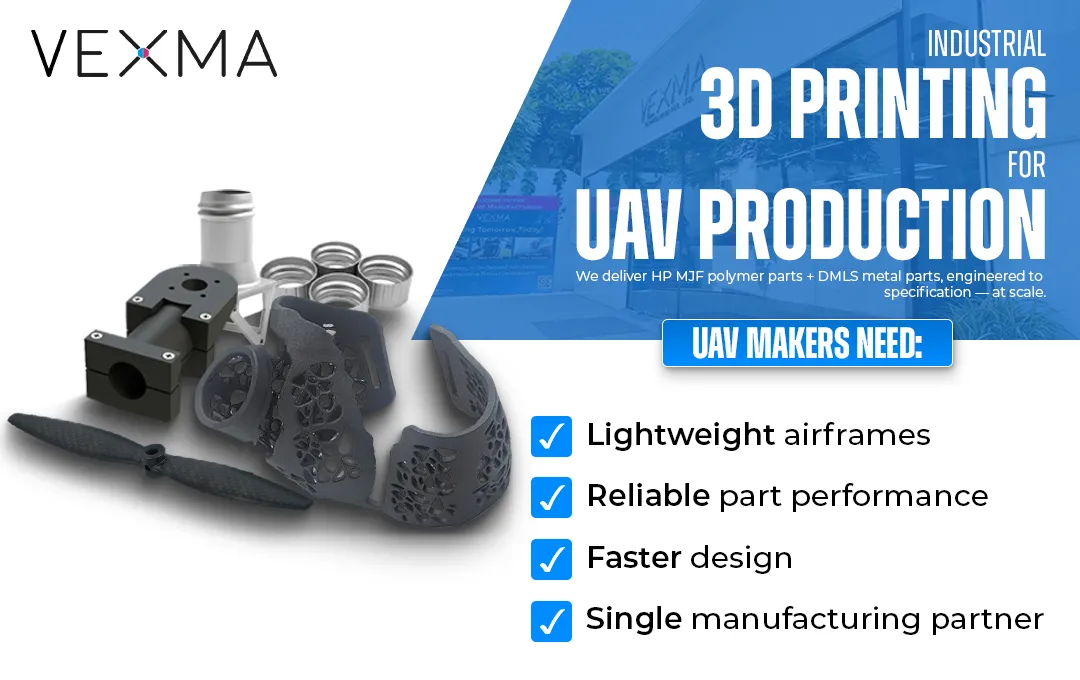
This is where industrial 3D printing (additive manufacturing) has proven to be far more than a prototyping tool. Technologies such as HP Multi Jet Fusion (MJF) and industrial metal additive manufacturing now enable repeatable, validated, and scalable production of UAV parts that meet real-world operational requirements.
In this blog, we explore how industrial 3D printing bridges the gap between prototype and production, and why it has become a trusted manufacturing solution for flight-ready UAV components.
The Prototype-to-Production Challenge in UAV Manufacturing
UAV development cycles are fast, but operational expectations are unforgiving. A prototype that performs well in lab testing may fail when exposed to vibration, heat, UV exposure, dust, moisture, or long flight hours. Traditional manufacturing methods often introduce bottlenecks at this stage.
Common challenges include:
-> Tooling delays when moving to injection molding or casting
-> High upfront costs for low-to-medium production volumes
-> Design compromises to suit machining constraints
-> Inconsistent mechanical properties across batches
Our online 3D printing services address these issues by allowing manufacturers to validate, iterate, and scale using the same process and material set, eliminating the disconnect between prototype and production.
What Makes a UAV Part “Flight-Ready”?
A flight-ready UAV component must meet far more stringent requirements than a visual or form-fit prototype. These typically include:
-> Mechanical strength and durability under dynamic loads
-> Dimensional accuracy and repeatability across batches
-> Material consistency suitable for long-term use
-> Lightweight design without compromising structural integrity
-> Environmental resistance (temperature, chemicals, UV)
Industrial 3D Printing: Built for Production, Not Just Prototypes
1. Consistent, Production-Grade Materials
Modern UAV programs increasingly rely on engineering-grade polymers such as PA12 and PA11, commonly used in HP Multi Jet Fusion. These materials offer:
-> High strength-to-weight ratio
-> Excellent fatigue resistance
-> Chemical and environmental stability
-> Proven performance in end-use applications
2. Isotropic Strength for Real-World Flight Loads
Traditional FDM 3D printing often produces anisotropic parts - strong in one direction and weak in another. This is unacceptable for UAV structures exposed to multi-directional stresses.
Industrial processes like MJF produce isotropic mechanical properties, meaning:
-> Equal strength in X, Y, and Z axes
-> Reliable performance regardless of orientation
-> Reduced risk of in-flight failure
3. No Support Structures = Design Freedom
UAV components often include:
-> Internal air channels
-> Thin-wall enclosures
-> Complex mounting geometries
MJF’s powder-bed process eliminates the need for support structures, enabling:
-> Complex internal geometries without post-processing
-> Cleaner internal surfaces
-> Faster production cycles
4. Repeatability and Batch Control
Flight-ready production demands consistency - not just one successful print.
Industrial 3D printing systems are designed for:
-> Controlled thermal behavior
-> Tight dimensional tolerances
-> Batch-to-batch repeatability
5. Lightweighting Through Design, Not Compromise
Weight reduction directly translates to:
-> Longer flight times
-> Higher payload capacity
-> Improved energy efficiency
Additive manufacturing enables topology optimization and lattice structures that are impossible with CNC machining or molding.
Typical UAV Components Successfully 3D Printed
Industrial 3D printing is already used for a wide range of flight-ready UAV components, including:
-> Structural frames and brackets
-> Electronic housings and enclosures
-> Battery casings
-> Antenna mounts and sensor housings
-> Air ducts and cooling channels
-> Custom jigs and fixtures for UAV assembly
These components benefit from reduced part count, integrated features, and faster design validation.
When 3D Printing Outperforms Traditional Manufacturing
| Requirement | Traditional Manufacturing | Industrial 3D Printing |
|---|---|---|
| Tooling required | Yes | No |
| Low-volume cost efficiency | Low | High |
| Design complexity | Limited | Very high |
| Iteration speed | Slow | Fast |
| Bridge to production | Difficult | Seamless |
For UAV programs operating in fast-changing markets or R&D-driven environments, additive manufacturing provides unmatched agility.
Why OEMs and Startups Trust Industrial 3D Printing for UAVs
Both established aerospace OEMs and emerging drone startups rely on industrial 3D printing because it offers:
-> Faster time-to-market
-> Lower upfront investment
-> Design freedom without penalties
-> Reliable, repeatable part quality
In competitive UAV markets, these advantages often determine who reaches deployment first.
How Vexma Enables Flight-Ready UAV Manufacturing
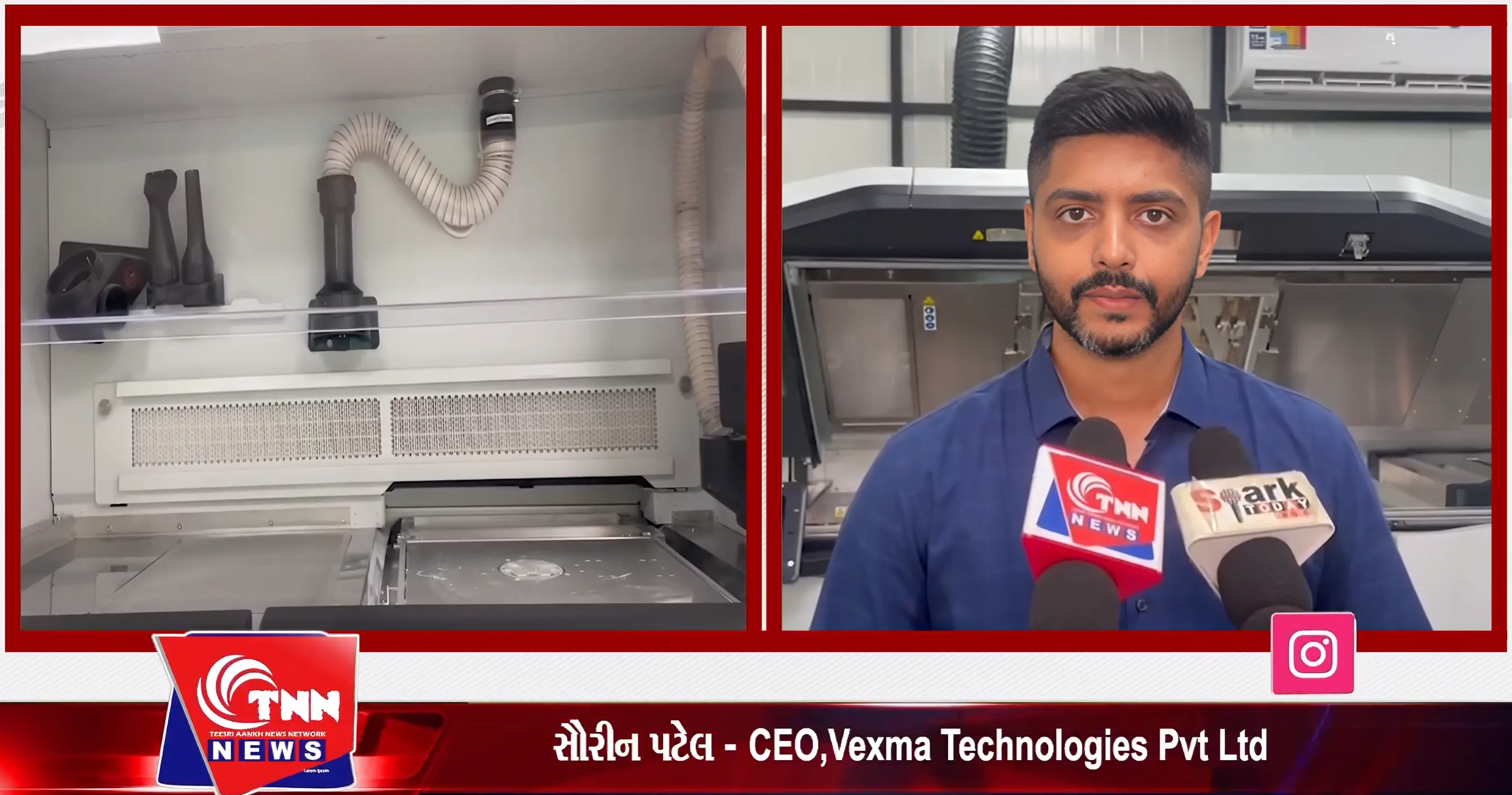
At Vexma Technologies, we support UAV and aerospace teams throughout the complete product development lifecycle - from concept validation to production-ready manufacturing using advanced 3D printing services in India.
Our capabilities include:
-> HP Multi Jet Fusion (MJF) for polymer UAV parts
-> Engineering-grade materials suitable for end-use
-> Design for Additive Manufacturing (DfAM) support
-> Batch production with controlled quality
-> Fast turnaround without tooling constraints
Whether you’re validating a new UAV platform or preparing for low-volume production, we help ensure your parts are built for flight - not just for display.
Conclusion: The Future of Flight-Ready UAV Manufacturing
Industrial 3D printing has permanently changed how UAV components are designed, validated, and produced. No longer limited to prototyping, additive manufacturing now delivers production-grade, flight-ready parts that meet the demanding requirements of modern UAV applications.
If you’re evaluating whether your UAV component is ready for flight-grade manufacturing, Vexma can help.
👉 Explore our 3D Printed Drone Solutions
👉 Learn more about Vexma’s Drone Manufacturing Capabilities