3D Printing for Robotics

3D Printing Solutions for Robotics Applications

Reliable, affordable, and customizable 3D printing solutions designed to support robotics development from rapid prototyping to functional, production-ready parts.

Get Your Instant Quote
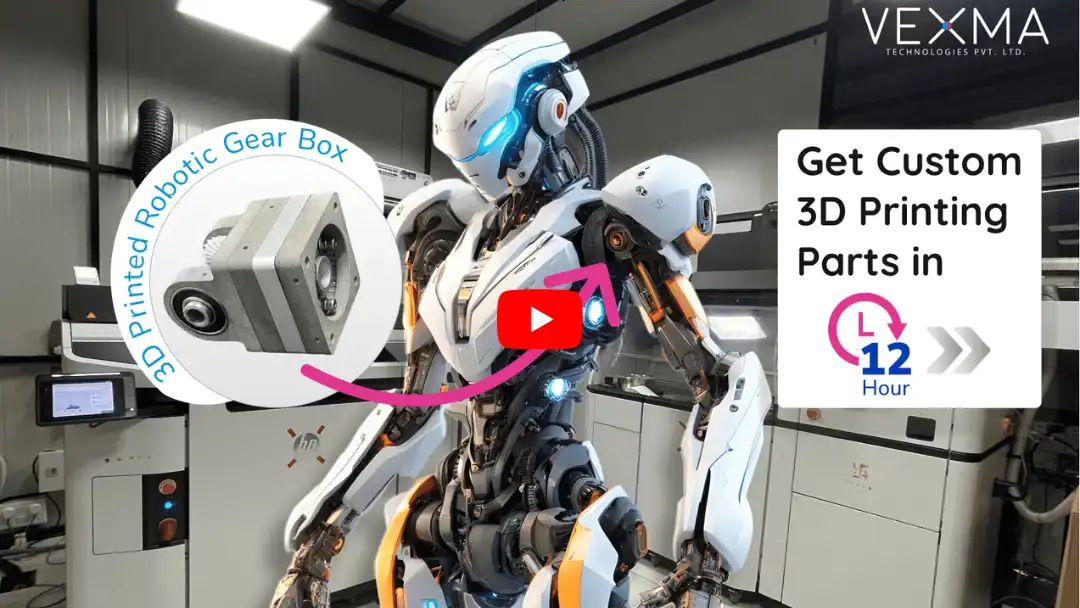
Robotic Arm gearbox by Vexma

Driving Innovation, Speed & Efficiency: Robotics Industry

Additive Manufacturing is transforming the robotics industry by enabling faster development, greater design freedom, and cost-effective production of complex robotic components. As industrial automation and smart manufacturing continue to evolve, 3D printing in robotics plays a critical role in supporting innovation across industrial automation solutions, commercial robotics, and research-driven robot technology applications.


From early-stage prototypes to functional end-use parts, 3D printing and robotics work together to accelerate development cycles and enable scalable automation in manufacturing industry environments. With Vexma’s online 3D printing services, robotics and automation manufacturers achieve faster development, optimized robotic parts, and flexible production without the constraints of conventional manufacturing.


Key Benefits of 3D Printing for Robotics & Automation


Rapid Prototyping & Fast Iteration

Robotics and automation engineering is highly iterative. With robotics 3D printing, engineers can move from CAD designs to physical parts within days. This significantly reduces development timelines for robotic machinery, industrial robot components, and automated solutions, enabling faster validation of form, fit, and function.

This speed is essential for robotics in manufacturing, robot arm 3D models, and evolving robotics applications across industries.

Extreme Customization & Design Freedom:

Every industrial robot industry application has unique requirements. 3D printing in robotics allows complete customization of geometries, mounts, attachment systems, and internal features without the constraints of traditional manufacturing.

This makes it ideal for robotics and automation technology, industrial automation products, custom robotic arms, and application-specific automation robotics systems.

Lightweight yet Strong Structures:

Weight reduction is critical for industrial robot arms, mobile robots, drones, and collaborative robots. Additive manufacturing enables topology-optimized designs that maintain structural strength while minimizing weight.

Lightweight robotic arm manufacturers and automotive manufacturing robots benefit from improved energy efficiency, higher payload capacity, and enhanced performance in smart factory environments.

Integration of Multiple Functions:

3D printing enables part consolidation by integrating multiple functions into a single printed component. Wiring channels, electronic housings, joints, airflow paths, and mounting features can be produced together.

This approach reduces assembly complexity, improves reliability, and lowers costs for industrial robotic automation, manufacturing process automation, and robotic process automation technology.

Cost-Effective for Small Batches & Custom Builds:

Unlike traditional tooling-based manufacturing, additive manufacturing is cost-effective for low-volume and custom production. This is especially valuable for robotic process automation companies, pilot projects, R&D programs, and automation machinery manufacturing.

3D printing supports flexible production of industrial robot parts, 3D printed robot arms, and robotic automation components without high upfront investment.

Why Additive Manufacturing Is a Game-Changer for Robotic Gearboxes

3D printing enables engineers to design and manufacture complex gearbox geometries that were previously difficult or impossible with conventional methods. Key advantages include:

• Lightweight yet durable designs for improved robot efficiency

• Custom-engineered components tailored to specific motion control needs

• Reduced part count through component integration

• Faster prototyping and iteration, accelerating development cycles

• Lower production costs for prototypes and low-volume manufacturing

Technologies such as Multi Jet Fusion (MJF) and Selective Laser Melting (SLM) allow the production of high-precision polymer and metal gearbox components suitable for demanding robotics applications.


Applications of 3D Printing in Robotics


• Industrial robot arms and frames
• Sensor housings and electronic enclosures
• End-effectors, 3D printed grippers, and tooling
• Mobile robot and AGV chassis
• Wearable robotics and prosthetics
• Drone and autonomous system components
• Robotics in automotive industry
• Industrial automation robotics systems

Why Use Additive Manufacturing for Robotics?

Additive manufacturing enables manufacturers to innovate faster, reduce costs, and build advanced designs that are difficult or impossible with conventional methods. From concept validation to production-ready parts, 3D printing in robotics supports the complete lifecycle of manufacturing and automation.
As robotics engineering continues to shape the future of smart factories and automated solutions, additive manufacturing remains a key enabler of scalable, efficient, and intelligent robotic systems.


This proven performance is why industry leaders integrate multi jet fusion into their core manufacturing workflows.


Common Challenges in Robotics 3D Printing & How They Are Addressed

Material selection and process optimization are key to achieving reliable robotic parts. Advanced industrial materials help overcome common challenges related to strength, flexibility, temperature resistance, and electronic safety.


Recommended Materials for Robotics Applications

PA12 (Nylon): Provides an excellent balance of mechanical strength, stiffness, and lightweight performance. Commonly used for industrial robot components, enclosures, and structural frames in robotics in manufacturing.
PA12 Glass-Filled / Carbon-Filled (GF / CF): Reinforced materials offering higher stiffness and load-bearing capability, suitable for industrial robot applications and robotic arm manufacturers.
TPU (Thermoplastic Polyurethane): Flexible and impact-resistant material used for 3D print grippers, joints, dampers, bearings, and protective robotic surfaces.
PEEK: A high-performance polymer resistant to high temperatures and chemicals, ideal for industrial automation solutions operating in harsh environments.
Medical ABS: Used in robotics in healthcare, wearable robotics, and prosthetics due to its dimensional stability and biocompatibility.
PETG: Anti-static material designed for electronics-heavy robotic systems, protecting sensitive components from electrostatic discharge while maintaining good mechanical strength ideal for robotics and automation engineering applications.


Our 3D Printing Technologies

We utilize proven additive manufacturing technologies to meet demanding robotics requirements:


Multi Jet Fusion (MJF): for strong, repeatable polymer parts
SLS & SLA : for precision components
Metal 3D Printing (SLM / DMLS): for high-strength metal parts
Post-processing & finishing: for production-ready components

faq-image

Frequently Asked Questions

3D printing is used in robotics and automation to design, prototype, and manufacture complex components such as robotic arms, enclosures, grippers, joints, and structural frames. It enables faster development, greater design flexibility, and cost-effective production compared to traditional manufacturing methods. ​
3D printing accelerates robot development by enabling rapid prototyping, easy design iteration, lightweight structures, part consolidation, and customization. It also reduces lead times and eliminates the need for expensive tooling, making it ideal for innovation-driven robotics projects.
Yes, 3D printing is widely used to produce functional robotic parts capable of handling mechanical loads, motion, and operational stress. Industrial-grade materials and technologies allow parts to be used for testing, pilot production, and even end-use applications.
Common materials include PA12 and reinforced nylons for structural strength, TPU for flexible components, high-performance polymers for demanding environments, and ESD-safe materials for electronics-heavy robotic systems.
Absolutely. 3D printing allows complete customization of robotic components without tooling constraints, making it ideal for application-specific designs, multiple variants, and rapid design updates.
3D printed parts are designed to meet precise dimensional and functional requirements, allowing seamless integration into existing robotic systems, assemblies, and automation workflows.
3D printing is highly cost-effective for prototypes, custom builds, and low-to-medium volume production. It reduces tooling costs, minimizes material waste, and shortens lead times, making it a practical solution for robotics manufacturing.

Start Your Robotics Project Today!

Experience professional 3D printing at your fingertips. Just upload your 3D files, select your preferred material and technology, and order online. We’ll take care of everything from production to delivery.

Get an Instant Quote
call-to-action

Experience the Cutting-Edge World of Rapid Prototyping

With Our 10+ Years of Expertise, We are your trusted partners in turning your visions into tangible prototypes.

Get Every Single Updates

Talk to our experts
dots-circle
Shape