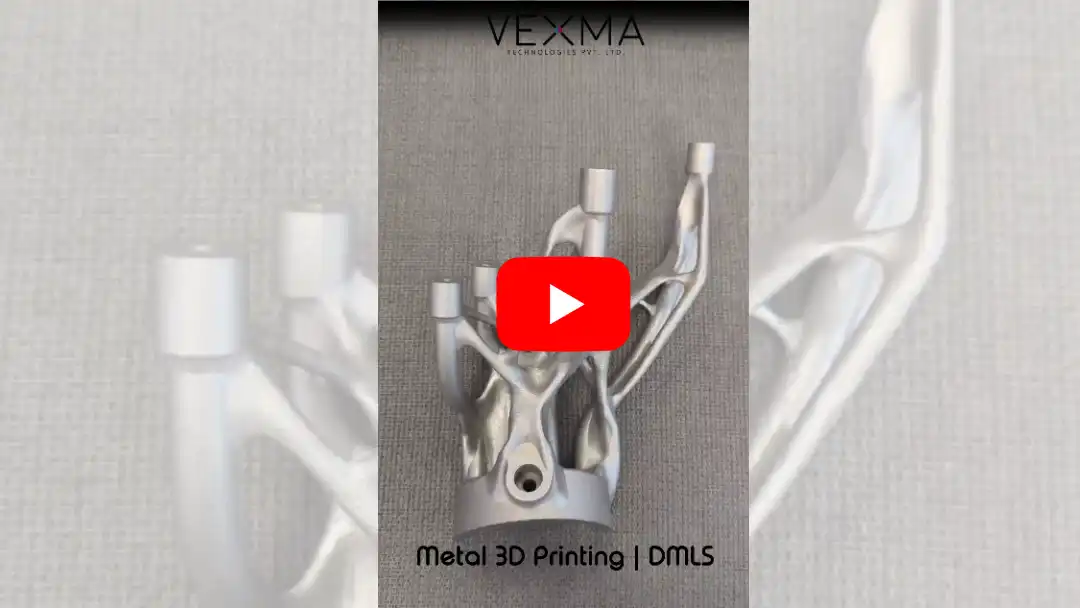
Advanced Topology-Optimized 3D Printed Stainless Steel Component
Topology optimization is changing how engineers approach the design of high-performance components. Instead of starting with a conventional geometry and adapting it to manufacturing limitations, engineers can use simulation-driven design to determine where material is needed for structural performance and where it can potentially be removed.
When combined with metal 3D printing, topology optimization enables the production of complex stainless steel components with geometries that can be difficult or impractical to manufacture using conventional methods.
The component showcased here demonstrates this approach, using an optimized geometry to reduce unnecessary material while maintaining the structural requirements of the intended application.
Why Metal 3D Printing?
Conventional machining often requires tool access and can involve removing substantial material from a larger block.
Metal additive manufacturing builds the component layer by layer directly from a digital model, providing greater freedom for producing complex geometries.
This makes metal 3D printing particularly relevant for applications where weight, structural performance and geometric complexity are important.
Stainless steel 3D printing is widely used for engineering components where durability, mechanical performance and corrosion resistance are important considerations.
Combining stainless steel with additive manufacturing allows engineers to explore complex component designs while retaining the benefits of the selected material.
Why Use Topology Optimization?
Topology optimization uses design constraints, loads and material properties to identify areas where material can potentially be removed or redistributed. This can help engineers:
• Reduce unnecessary component weight
• Optimize material usage
• Improve load paths
• Create complex geometries
• Consolidate multiple components
• Explore designs beyond conventional manufacturing limitations
The objective isn't simply to make a component lighter. The optimized design must still meet the required strength, stiffness, durability and application-specific requirements.
From Design to 3D Printed Component
A typical workflow includes:
Design Requirements → Topology Optimization → DfAM → Simulation & Validation → Metal 3D Printing → Post-Processing → Inspection
Design for Additive Manufacturing (DfAM) is an important part of this process. Factors such as build orientation, support structures, feature size, overhangs, post-processing and inspection need to be considered before manufacturing.
The objective is to create a design that is not only optimized digitally but also practical to manufacture using metal additive manufacturing.
Where Can These Components Be Used?
Custom metal components can be explored for applications across:
• Aerospace
• Automotive
• Robotics
• Industrial machinery
• Engineering equipment
• Performance-critical systems
The suitability of design depends on the specific loads, material, manufacturing process and application requirements.
Ready to Turn Your Optimized Design into Metal?
Exploring Metal 3D Printing for Your Component?
Share your 3D model with our team to evaluate its suitability for metal 3D printing.
Get Your Part Manufactured
Upload your CAD file → Get a feasibility review → Receive a quote
Conclusion
Topology optimization is particularly useful for metal 3D printing when component weight, structural performance and geometric complexity are important. At Vexma Technologies, stainless steel additive manufacturing enables these optimized digital designs to be transformed into physical components while offering greater geometric freedom than many conventional manufacturing methods.