
The Shift Towards Smarter Defense Manufacturing
Modern defense systems are evolving rapidly. From autonomous vehicles and aerospace systems to smart battlefield equipment, manufacturers are under pressure to build components that are lighter, stronger, and more efficient.
However, traditional manufacturing methods often create limitations in achieving these goals.
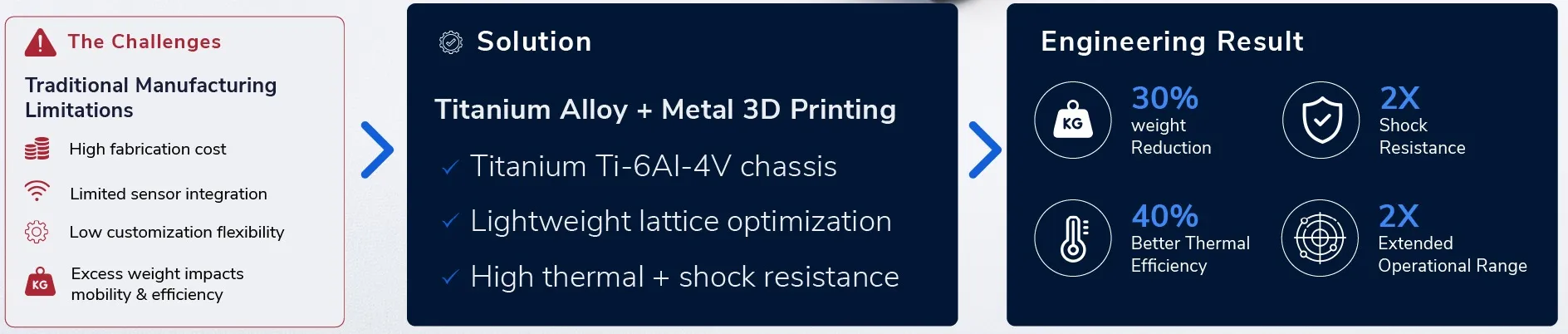
Conventional fabrication processes involve:
-> High production cost
-> Heavy assemblies
-> Long lead times
-> Limited design flexibility
-> Complex multi-part manufacturing
For advanced defense applications, these challenges directly impact performance and operational efficiency.
This is where metal additive manufacturing is transforming defense engineering.
Why Additive Manufacturing Matters in defense
Using technologies like DMLS (Direct Metal Laser Sintering), manufacturers can produce highly optimized metal components directly from digital CAD models.
Unlike traditional machining, metal 3D printing allows engineers to create:
-> Lightweight lattice structures
-> Integrated assemblies
-> Complex internal geometries
-> Optimized thermal management designs
-> High-strength lightweight parts
This enables greater design freedom while reducing overall system weight.
The Role of Titanium in Defense Manufacturing
Titanium Ti-6Al-4V is widely used in aerospace and defense because of its:
-> High strength-to-weight ratio
-> Corrosion resistance
-> Thermal stability
-> Shock resistance
-> Long-term durability
When combined with additive manufacturing, titanium enables the development of lightweight yet highly durable defense structures.
Applications include:
-> Unmanned ground vehicles
-> Aerospace components
-> Sensor-integrated systems
-> Tactical equipment
-> Lightweight chassis structures
Key Engineering Benefits
-> Weight Reduction: Additive manufacturing enables topology optimization and lattice structures that reduce unnecessary material while maintaining strength.
-> Better Thermal Performance: Internal cooling channels and advanced heat-management structures can be integrated directly into components, improving thermal efficiency and reliability.
-> Improved Shock Resistance: Optimized titanium structures help withstand vibration, impact, and harsh operating conditions common in defense environments.
-> Faster Development Cycles: Metal 3D printing enables faster prototyping and rapid design iteration without expensive tooling changes, reducing product development timelines.
The Future of defense Manufacturing
Defense innovation is moving toward:
-> Agile manufacturing
-> Digital production workflows
-> Lightweight engineering
-> Faster development cycles
-> On-demand manufacturing
Instead of designing around manufacturing limitations, engineers can now design around performance.
That shift is shaping the future of defense manufacturing.
This reduces dependency on long supply chains and enables a more agile maintenance model.
Conclusion
Metal additive manufacturing is helping defense manufacturers build lighter, stronger, and more advanced systems with improved performance and reduced production complexity.
As aerospace and defense technologies continue evolving, additive manufacturing will play a critical role in enabling next-generation engineering solutions.
If you're exploring titanium additive manufacturing or lightweight engineering solutions for defense applications, Vexma can help identify the right manufacturing approach for your requirements.