3D Printing in Metal
Transforms digital designs into precise metal parts with unparalleled speed and precision.

With over 11+ years of industrial manufacturing experience, Vexma delivers advanced 3D printing and additive manufacturing services in Germany, helping businesses accelerate product development and production.
From rapid prototyping to end-use components, we transform ideas into high-performance parts using industrial-grade plastic and metal 3D printing technologies.
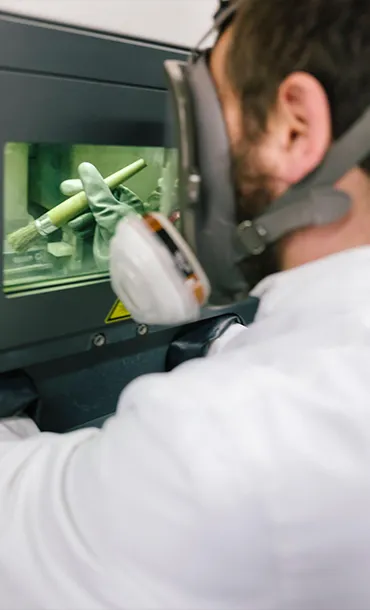


As demand for additive manufacturing in Germany continues to grow across automotive, aerospace, robotics, and industrial sectors, companies require fast, flexible, and cost-efficient production solutions.
Vexma supports German businesses with reliable, scalable, and engineering-driven 3D printing services, eliminating long lead times and expensive tooling.
Vexma is an additive engineering and advanced manufacturing partner, delivering consistent quality and production-ready results.
What Sets Us Apart
• Industrial Additive Manufacturing Expertise
• Online 3D Printing & Print-on-Demand Services
• Plastic & Metal 3D Printing Services
• Design-to-Manufacturing Support
• Cost-Effective Prototyping & Short-Run Production
• Fast Turnaround & Scalable Production
We help you move from concept to production efficiently, without the delays and high costs of traditional manufacturing methods.
We use a wide range of industrial 3D printing technologies to meet diverse application requirements:
• Fused Deposition Modeling (FDM Printing)
• Stereolithography (SLA Printing)
• Selective Laser Sintering (SLS Printing)
• Multi Jet Fusion (MJF 3D Printing)
• Metal 3D Printing
These technologies enable the production of complex geometries, lightweight structures, and functional end-use parts with excellent repeatability and precision.
Our plastic 3D printing services support rapid prototyping and functional production, using materials such as:
• ABS
• Nylon(PA12)
• Polycarbonate
• TPU
• Glass- and carbon-filled composites
Applications include:
• FDM 3D printing for functional prototypes
• SLS & MJF for durable nylon production parts
• SLA printing for high-detail resin components
Our metal additive manufacturing services in Germany are ideal for applications requiring strength, heat resistance, and mechanical reliability.
• Metal 3D printing for industrial components
• Custom metal prototypes and low-volume production
• Complex geometries and lightweight metal parts
Suitable for automotive, aerospace, robotics, electronics, and heavy engineering applications.
Speed is critical in today’s competitive manufacturing environment. Our rapid prototyping services in Germany enable faster design validation and iteration - often within days.
• 3D modeling for printing
• Reverse engineering & design optimization
• 3D scanning and printing
• Custom 3D printing on demand
This approach reduces development risks, shortens lead times, and lowers overall manufacturing costs.
Vexma’s online 3D printing services in Germany allow businesses to scale production without investing in molds or tooling.
• Print-on-demand manufacturing
• Low- to medium-volume production
• Consistent quality across batches
• Flexible production scaling
Whether you need a single prototype or recurring production, our solutions adapt to your business needs.
• Electronics & Electrical Engineering
Quality, reliability, and engineering excellence are at the core of everything we do. By combining advanced 3D printing technologies, additive engineering, and manufacturing expertise, Vexma helps German businesses bring innovative ideas to life - faster and smarter.
👉 Start your project today with Vexma’s 3D Printing Services in Germany

Transforms digital designs into precise metal parts with unparalleled speed and precision.

Utilizes SLA, MJF, FDM, and SLS technologies to create customized plastic designs with efficiency and versatility.

Producing high-quality components cost-effectively in small-batch production runs, offering diverse materials & finishes.

Optimizing product performance using FEA and CFD to assess structural integrity and fluid flow.

Integrating market research, CAD modeling, and Rapid Prototyping for a seamless journey from idea to market-ready solutions.

Replicating components using 3D scanning and modeling, facilitating product enhancements or replication.
Happy Clients
Project Complete
Years Of Experience
Parts Printed

Get More Technical Updates
With Our 10+ Years of Expertise, We are your trusted partners in turning your visions into tangible prototypes.
Get Every Single Updates
Talk to Sales
3D Printing, or Additive Manufacturing, has profoundly impacted numerous industries, revolutionizing traditional production methods.
In Aerospace, it enables the creation of lightweight and intricate components, enhancing fuel efficiency and performance without Compromising its strength.
The Healthcare and Medical sectors benefit from 3D printing's capability to produce custom implants, prosthetics, and even organs.
Automotive Manufacturers utilize it for rapid prototyping, customized parts, and the production of lightweight components, contributing to enhanced vehicle efficiency.
In Consumer Goods (FMCG), 3D printing allows for personalized designing and On-Demand low batch manufacturing resulting in companies to quickly iterate and test product designs, ensuring efficient development processes.
The Robotics Industry leverages its flexibility to produce complex and tailored components, fostering innovation.
Electrical Vehicle(EVs) manufacturers benefit from the lightweight and efficient designs achievable through 3D printing.
In the Defense Sector, it facilitates rapid prototyping, on-demand spare part production, and the creation of specialized components.
The Drone Industry utilizes 3D printing for lightweight structures and intricate designs, optimizing performance